Risk Versus Reward
07 Nov 2026

A rakeback percentage is easy to advertise. Before your casino offers it, the important question is what that percentage is applied to.
Returning a share of wagering and returning a share of the house edge produce very different costs. Understanding that distinction gives an operator a clearer basis for designing rewards and comparing its offering with competitors.
A 3.5% rakeback rate based on the house edge is calculated by multiplying the amount wagered by the game’s house edge, then multiplying that amount by 3.5%. It returns a share of theoretical gaming revenue, rather than 3.5% of every stake.
Consider an illustrative $1 million wagered on games with a 2% house edge. The expected gaming revenue is $20,000. Applying a 3.5% rakeback rate to that amount produces $700 in rewards. Applying the same percentage directly to wagering would produce $35,000—more than the expected gaming revenue before any other costs.
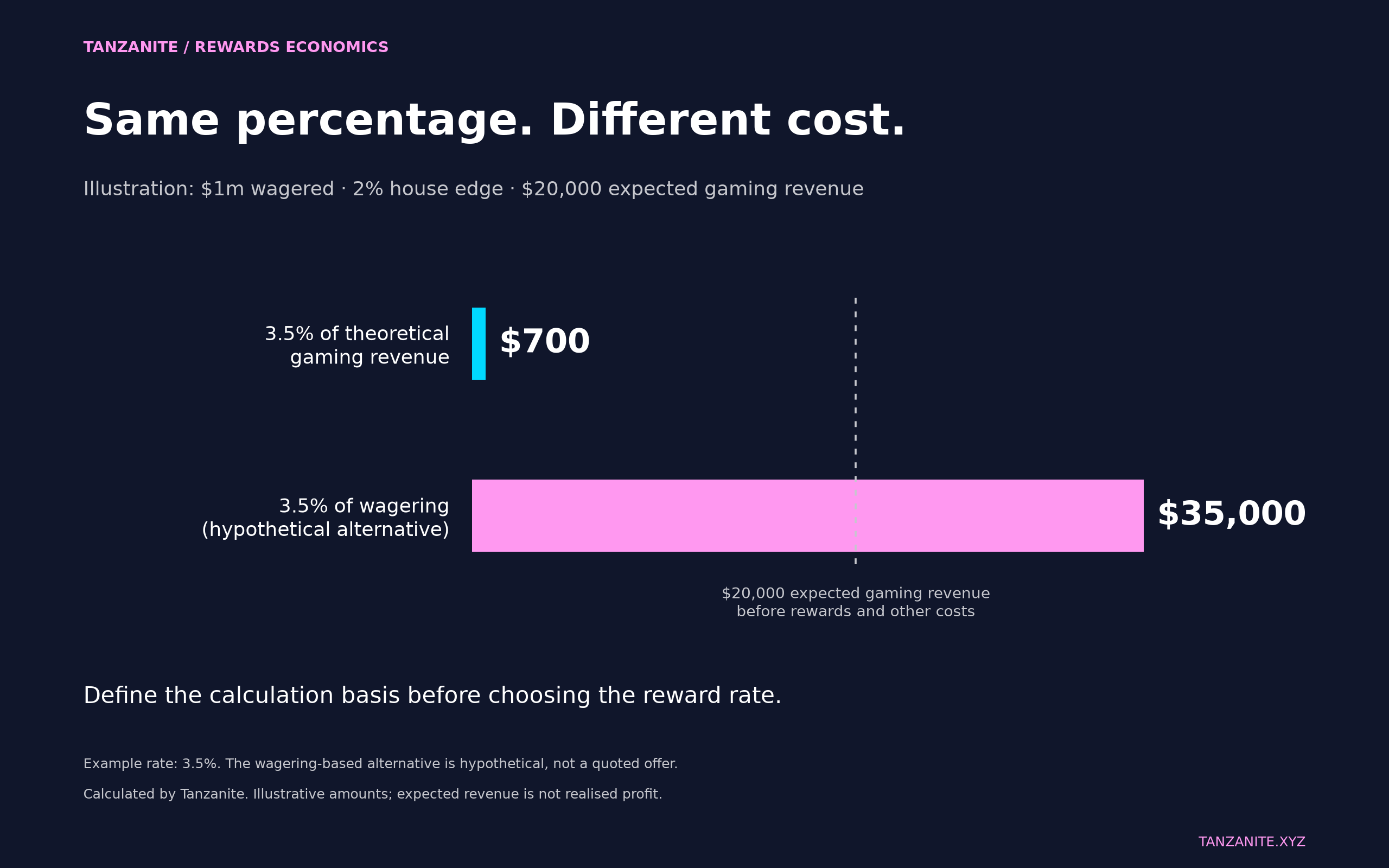
That is why the calculation should come before the headline offer. The percentage alone cannot tell your team what a reward will cost, or give customers enough information to understand what they will receive.
The choice of calculation also affects how the scheme responds to different games. When rewards are based on theoretical gaming revenue, a lower-edge game generates a smaller reward for the same amount wagered. A flat percentage of wagering stays the same. Your game mix therefore matters when assessing whether the proposed reward is affordable.
Theoretical revenue is a planning measure, however. Actual results can differ, while an earned reward may still be payable. Under a reward formula based on wagering and house edge, customers earn rakeback whether they win or lose. For an operator, that makes reward payments a funding consideration as well as a margin calculation.
Rakeback also needs to sit within the wider rewards budget. If your offering includes weekly bonuses, monthly bonuses or discretionary VIP benefits, each adds to what the customer receives. A sustainable instant-rakeback rate does not establish that the combined package is sustainable.
For a new scheme or a review of an existing one, the decision is the reward your casino can support under clearly defined terms. That starts with the calculation basis, the games and customers eligible, and the other benefits paid alongside it. A competitor’s headline rate is useful context; your own costs determine what you can offer.
Tanzanite includes Rewards & VIP within its product audits, alongside bankroll-management advisory. We can help you examine how your reward structure fits your game offering and how clearly it is presented to customers.
Talk to Tanzanite about reviewing the economics behind your casino’s rewards.
Sources:
Tanzanite solutions