When Is a New Market Worth Localising Your Casino For?
23 Nov 2026

A translated casino can still feel foreign at the cashier. A customer might understand every word on the site and still have no familiar way to deposit, withdraw or get help when a payment goes wrong.
That makes casino localisation an investment decision. When your current setup already works for customers in a market, adapting it may be enough. When it asks them to change how they pay or leaves your team unable to support them, there’s a stronger case for building a dedicated local experience.
Where does the existing casino fall short?
Local payment habits can make a big difference to what customers expect. Brazil’s central bank reported that the number of Pix transactions rose 24.3% in the second half of 2025 compared with the same period in 2024. That measures payment activity across the economy. For an operator assessing the market, it makes Pix a method worth investigating with the intended audience before assuming the existing cashier will do. Banco Central do Brasil retail payment statistics
Look at the customers your casino can serve and where they get stuck. If deposits go through but customers struggle to understand the withdrawal instructions, clearer copy and local-language support may address the problem. If customers regularly reach the cashier and ask for a payment method you don’t offer, that’s a reason to price a local integration and check whether it can handle payouts as well.
The lobby can tell a similar story. A translated game category may be easy to understand while still putting the wrong titles up front. If customers can already find the games they want through search, changing a few featured rows might be enough. A dedicated local lobby makes more sense when the existing selection repeatedly misses what that audience comes to play. Assessing proprietary games in your catalogue
When does a dedicated setup earn its cost?
Consider a market where a local payment integration and the support to run it would cost an extra $6,000 a month. If the casino expects $30 in contribution per additional active customer that month, after variable costs, it would need 200 additional active customers to cover that monthly bill. The figures are illustrative. If most of the take-up comes from customers switching from an existing payment option, the case depends on any savings or other measurable gains from that switch.
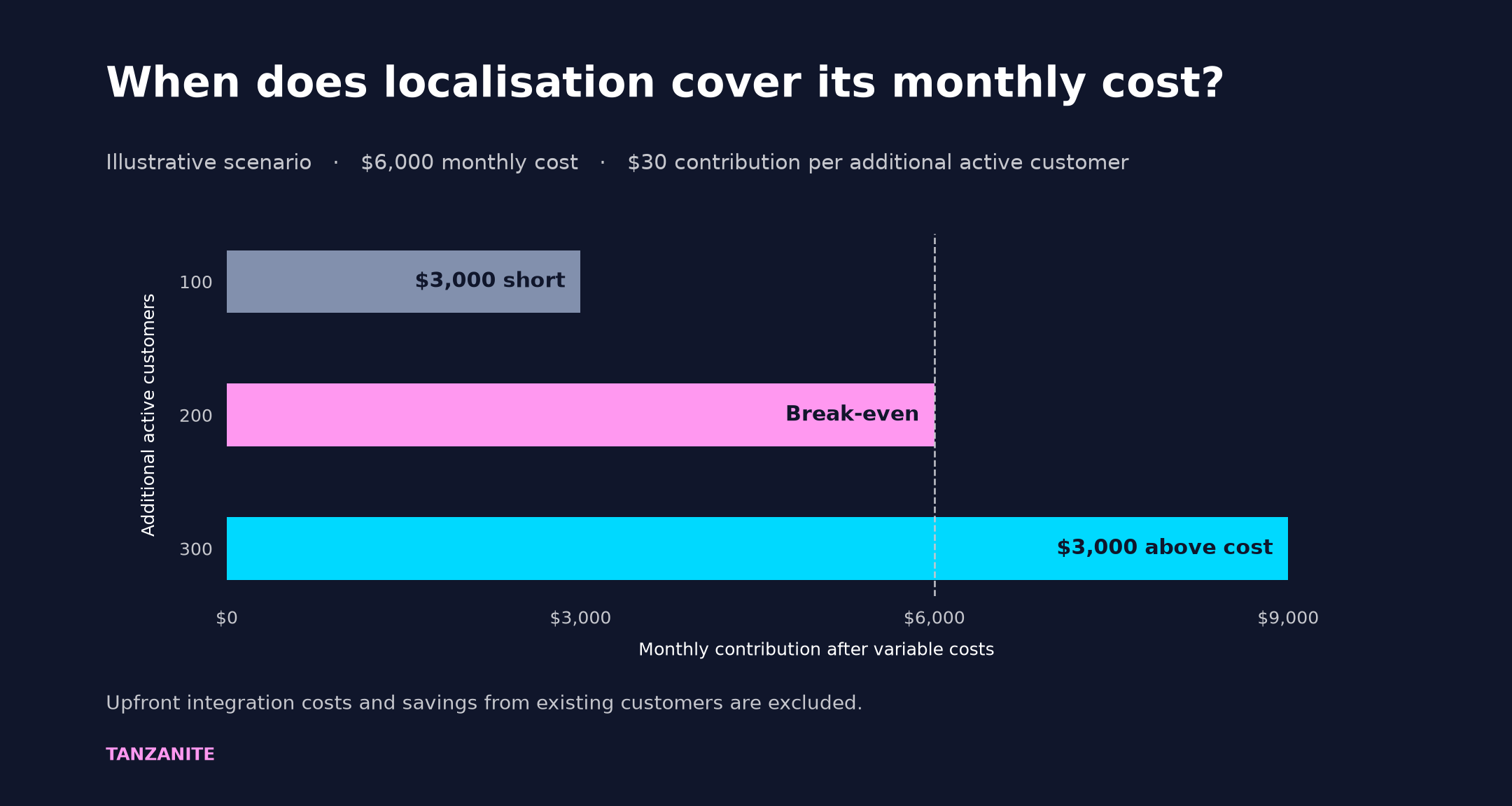
That’s a useful test before paying for a separate setup. A reliable local payout route may justify the investment on its own. In another market, the payment integration only makes sense with support that can explain it and handle delays in the customer’s language. Price the experience customers will actually receive, including any upfront work, and compare it with the gains you can reasonably expect.
Tanzanite can help review where customers get stuck and assess payment-provider options alongside the changes your product needs. Talk to Tanzanite about what to localise first in your next market. Tanzanite solutions